
UKREiiF 2026: Leadership Capability in a Market Balancing Caution and Change
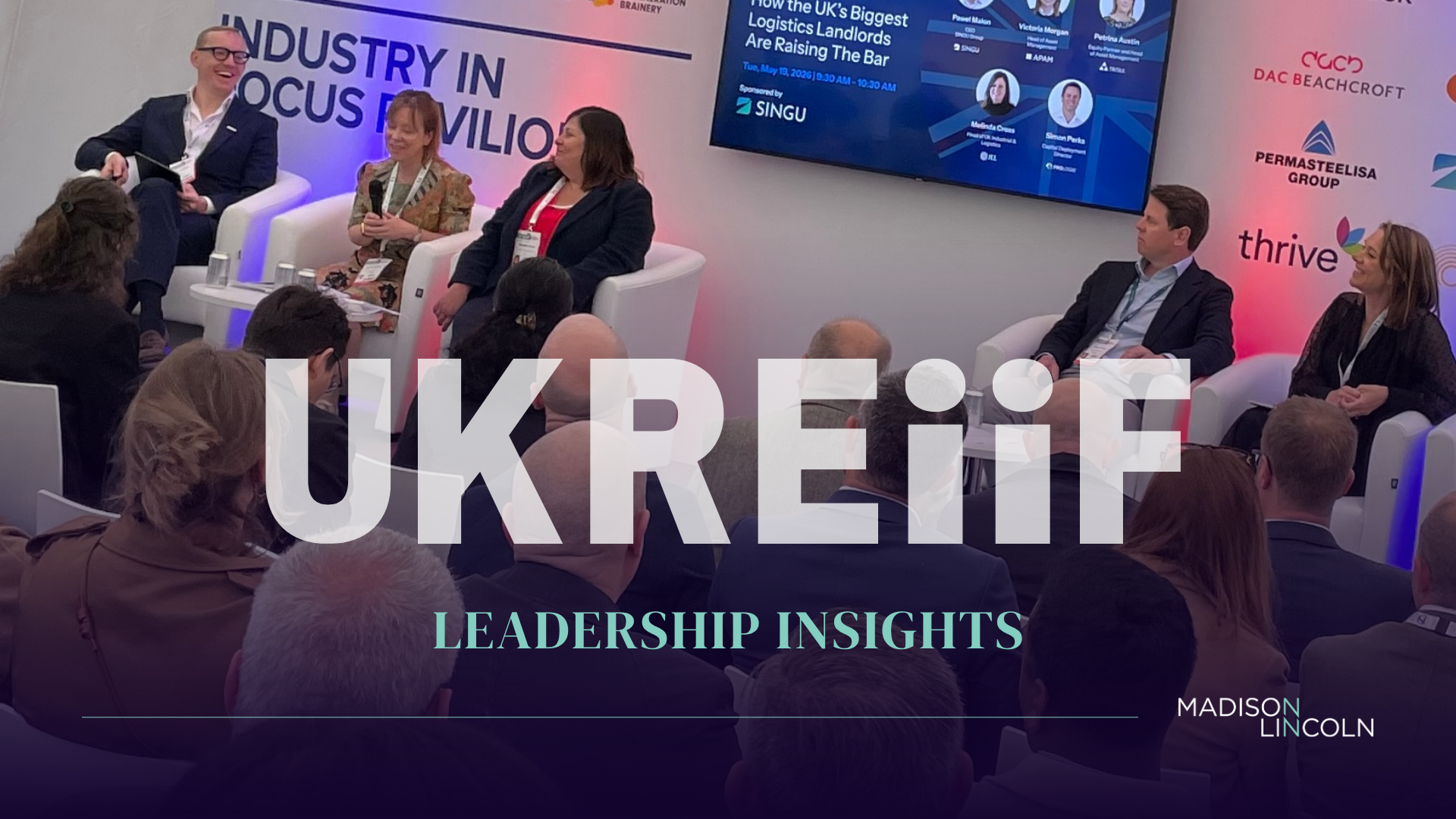
By Emma Burnaby-Atkins, Senior Director - Madison Lincoln
At UKREiiF this year, I was struck by how many of the conversations, challenges and opportunities emerging across different parts of the real estate market seemed, at their core, to hinge on the same underlying factor: leadership capability.
Across investors, developers, operators and advisers, there was a clear sense of a market still balancing caution with the need to adapt. Capital remains selective, decisions are being carefully weighed, and many businesses are still managing uncertainty around viability, funding and future demand.
At the same time, the pace of change is not slowing. AI, digital transformation, operational efficiency, changing customer expectations and new investment priorities are all reshaping how real estate businesses need to operate.
That creates an interesting tension. The market may be cautious, but the demands being placed on leadership teams are becoming more complex.
While conversations were not always explicitly about leadership, many seemed to reflect the same underlying question: whether organisations have the leadership capability required to navigate an increasingly complex and fast-moving market environment.
Leadership capability is not simply about experience or technical expertise. Increasingly, the differentiator seems to be leaders who can combine judgement, adaptability and clear communication, make effective decisions through uncertainty and translate change into commercial opportunity while the market itself continues to evolve.
AI and digital transformation formed part of the wider backdrop throughout the week, not necessarily as standalone discussion points, but as part of the broader pace of change businesses are now operating within, and the growing importance of leaders who can apply new technologies thoughtfully, prioritise effectively and translate change into meaningful commercial advantage.
Increasingly, organisations are recognising that the leadership capability required to navigate change doesn’t always need to sit solely within a permanent executive team. For many businesses, senior advisors, non-executive directors, interim leaders and fractional executives are becoming an increasingly important way of bringing in specialist expertise, external perspective and leadership capacity at key moments of change.
The importance of leadership capability also extends beyond immediate transformation or operational change. Growth, restructuring, market repositioning and expansion into new sectors all require organisations to think carefully about whether they have the leadership capacity and expertise required for what comes next. In a slower market, the instinct can be to wait until there is greater certainty before making senior appointments. But executive search, succession planning and notice periods all take time. Businesses that wait until a leadership gap becomes critical can quickly find themselves behind.
In a market where businesses are balancing caution with the need to adapt, leadership capability increasingly feels like one of the clearest differentiators between organisations able to navigate uncertainty confidently, respond to opportunity effectively and evolve with changing market conditions, and those struggling to keep up with the scale and complexity of change around them. Equally, for organisations where that capability is not yet fully in place, the challenge is recognising where additional leadership support or expertise may be needed before gaps become critical.
For us at Madison Lincoln, UKREiiF reinforced the extent to which talent, leadership and organisational readiness sit at the centre of many of the wider conversations shaping the market.
Thank you to everyone I spoke to in Leeds. It was great to catch up, compare perspectives and hear how different parts of the market are thinking about the year ahead.
If we didn’t get the chance to catch up at UKREiiF, but you’d like to have a conversation around leadership capability, succession planning or how your leadership structure supports future growth and change, we’re always happy to talk.