
The 12 days of Christmas - Leadership Insights from 2025
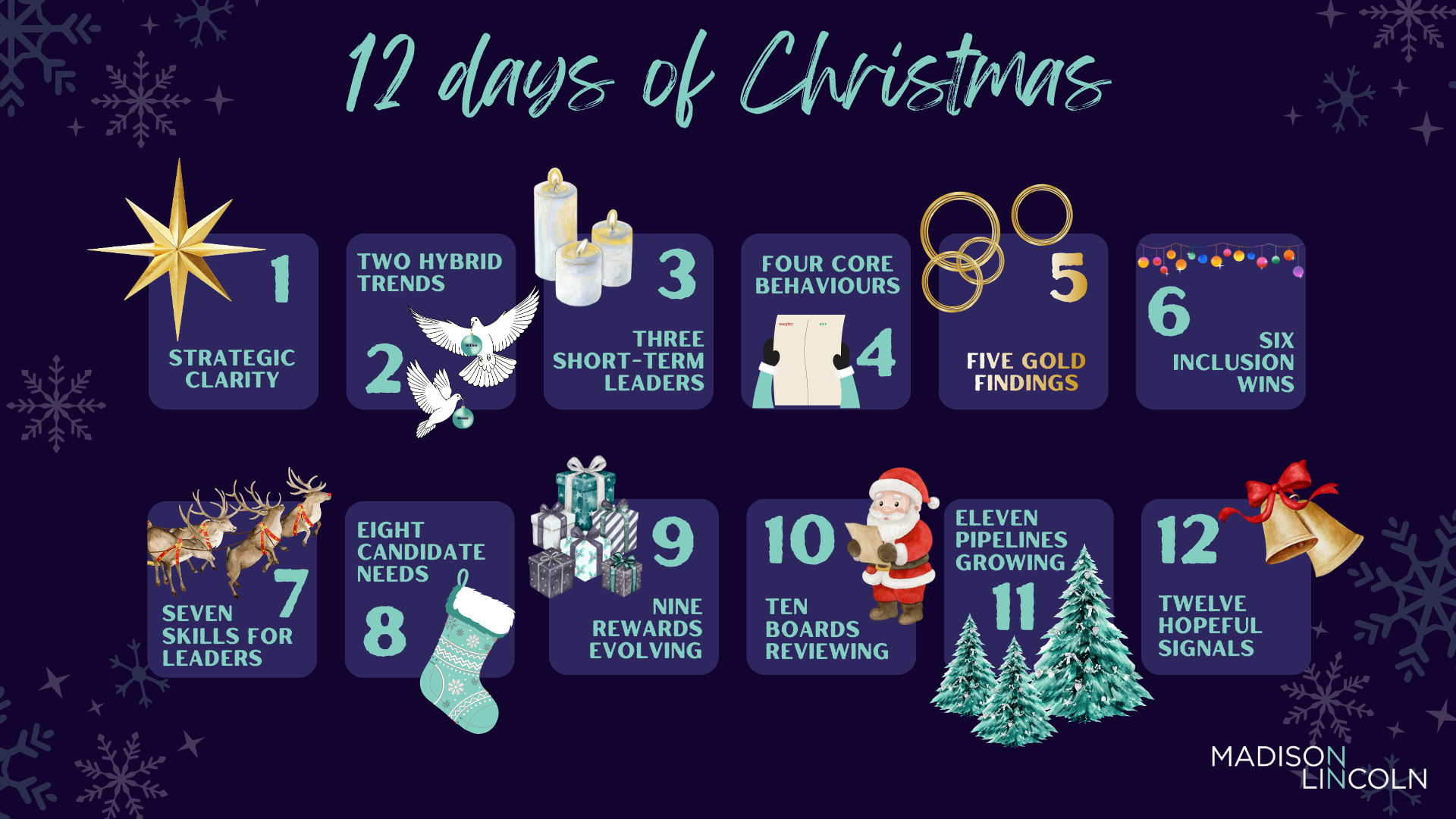
2025 was a year of pressure and recalibration across UK real estate leadership. Our 12 Days of Christmasseries captures the themes that stood out - the behaviours, capabilities and organisational shifts that shaped the year, and the signals pointing to a more resilient 2026. Below is the full collection, where each “day” distils one key insight.
🎄 On the First Day of Christmas, Madison Lincoln Gave to Me... Strategic Clarity
One of the strongest macro drivers of senior hiring this year has been the need for clearer, sharper commercial leadership. Across UK real estate, 2025 has been a year defined by complexity: capital constraints, higher operational costs, shifting occupier needs and slower decision cycles. Those pressures have pushed boards to refocus on something deceptively simple but increasingly critical - clarity of direction.
What we've seen across mandates:
• Sharp focus on exceptional commercial judgement in candidates
• Boards want leaders who can convert ambiguity into clarity and action
• The most in-demand leaders blend strategic fluency with operational realism - not just big-picture thinking, but the ability to prioritise and execute.
• Firms undergoing change (M&A, refinancing, restructuring, digitisation) are specifically seeking leaders who can rebuild confidence and alignment, internally and externally.
• Many firms are using interim and fractional leaders to inject clarity at pivotal moments — bringing immediate focus, stabilising teams and accelerating decision-making.
Strategic clarity has become one of the biggest catalysts for senior movement in 2025 - and one of the clearest indicators of which organisations will move fastest in 2026.
🎄 On the Second Day of Christmas, Madison Lincoln Gave to Me... Two Hybrid Trends
Return-to-office expectations have become one of the defining influences on senior hiring this year. Across our mandates - and echoed in our coverage in Property Week and Green Street News - two clear hybrid trends have defined 2025:
Trend 1: Attendance expectations are now a strategic constraint.
Firmer in-office requirements are narrowing the senior talent pool, particularly for leadership roles where the individuals won’t - or can’t - commit to four or five days a week on-site.
The knock-on effects are bigger than many boards expected:
Diversity - leaders with caring responsibilities are disproportionately affected.
Regional mobility - fewer candidates are willing to commute long-distance.
Retention - unclear or shifting expectations are prompting reassessments of long-term fit.
Pace - searches take longer where expectations are inflexible or ambiguous.
This is no longer just a policy detail — it’s shaping who organisations can hire and how quickly they can move.
Trend 2: Involving senior leaders in hybrid decisions improves alignment and retention.
The organisations navigating hybrid most effectively are those that co-design attendance expectations with their leadership teams, rather than imposing policies from the top down.
What this looks like:
Bringing leaders into the conversation early
Ensuring expectations align with how leadership teams operate day to day
Using leaders to communicate the rationale behind the model
When senior leaders help shape expectations, firms land on a model that works in practice - including for those with wider commitments - strengthening retention and widening the senior talent pool.
🎄 On the Third Day of Christmas, Madison Lincoln Gave to Me... Three Short-Term Leaders
Fractional and interim leadership has become a growing trend in 2025 - giving boards rapid access to senior capability without the commitment of a full-time hire. It’s helping real estate organisations bridge gaps, maintain momentum, de-risk key moments and accelerate growth.
Three things boards increasingly look for in fractional/interim leaders:
1. The Strategic Navigator
Steps in to set direction during periods of change - offering clarity, focus and high-calibre oversight when timing matters.
2. The Operational Fixer
Stabilises teams, drives execution and embeds structure for a defined period, especially when permanent hires are delayed or stretched.
3. The Objective Catalyst
Brings an external, unbiased perspective — challenging assumptions, unblocking decisions and accelerating transformation.
Short-term leaders aren’t a stop-gap - they’re becoming a strategic advantage.
🎄 On the Fourth Day of Christmas, Madison Lincoln Gave to Me... Four Core Behaviours
Across UK real estate, 2025 has tested leaders in ways that went far beyond strategy or technical capability. What distinguished the most effective executives this year were the behaviours they brought to complex, pressured and fast-moving environments - how they led when variables were shifting and certainty was limited.
Four leadership behaviours stood out consistently:
1. Commercial sharpness anchored in reality
Leaders who connected strategic ambition with operational pragmatism - making choices that balanced pace, risk and feasibility - delivered the clearest impact.
2. Visible, steady communication in ambiguity
Those who created clarity without overpromising, communicating honestly through moving parameters, kept teams aligned and confident.
3. Decisiveness with accountability
The strongest leaders demonstrated the ability to make timely calls and own them - reducing organisational drift and maintaining momentum when decisions became commercially or politically difficult.
4. Team-centered leadership
The focus here is core leadership capability rather than soft skills. Leaders who invested in their teams’ cohesion, wellbeing and clarity of purpose sustained performance under pressure and helped retain critical talent.
In a year defined by complexity, these four behaviours consistently correlated with stronger operational, commercial and cultural outcomes.
🎄 On the Fifth Day of Christmas, Madison Lincoln Gave to Me... Five Gold Findings
This year, several patterns emerged - signalling how leadership expectations, candidate behaviour and organisational priorities are shifting across the market.
Five ‘gold’ findings from 2025:
1. Leadership stamina has become a differentiator
Boards consistently reported that one strain of 2025 wasn’t capability, but sustained bandwidth. Executives who maintained pace, judgement and composure through prolonged volatility stood out.
2. Cross-functional literacy is now essential
Demand grew for leaders who can integrate decisions across functions. This breadth - the “leadership glue” - can be a decisive factor where complexity, transformation or growth pivots require more than functional depth.
3. Talent density matters more than headcount
Multiple organisations highlighted that small, high-capability teams outperformed larger teams with uneven talent distribution. Boards are now explicitly prioritising “talent concentration” in senior team design.
4. Boards are increasingly evaluating ‘change appetite’
Not just change skills, but willingness. Leaders who were energised by ambiguity, transformation and tough calls were consistently preferred over those more inclined toward stability or preservation.
5. Senior candidates are prioritising organisational credibility
Candidates are increasingly focusing on the conviction of the strategic rationale, governance strength or capital plan. Credibility has become a critical determinant of senior attraction and commitment.
Together, these five findings signal a market recalibrating its expectations of senior leaders - and a talent pool becoming more selective about the environments in which they can thrive.
🎄 On the Sixth Day of Christmas, Madison Lincoln Gave to Me... Six Inclusion Wins
Organisations making the most progress on ED&I in 2025 weren’t the ones with the most initiatives - they were the ones tightening focus and embedding inclusion into everyday leadership.
Across our conversations with senior leaders, six themes stood out:
1. Sharper - and fewer - priorities
High-performing organisations stopped spreading effort thinly and focused on inclusion priorities with real business impact.
2. Leaders held to account
Inclusion expectations were tied to objectives, feedback and performance discussions - not positioned as optional “good practice.”
3. Data used properly
They invested in better workforce data, making disparities visible and forcing clearer conversations about what needed to change.
4. Practical flexibility
Hybrid, hours and role-design decisions were made with inclusion in mind, improving retention for groups most affected by rigidity.
5. Transparent progression
Career pathways and criteria were demystified, reducing reliance on informal sponsorship and making advancement more predictable.
6. Real-world testing
New policies and processes were stress-tested with diverse employees before rollout, catching unintended consequences early.
Together, these moves shifted ED&I from “initiatives” to operational discipline - the hallmark of organisations that saw meaningful inclusion gains in 2025.
🎄 On the Seventh Day of Christmas, Madison Lincoln Gave to Me... Seven Skills for Leaders
If 2025 exposed the behavioural strengths that separated great leaders from good ones, it also clarified the capabilities organisations needed most. Seven leadership skills have been consistently prioritised - the ones that enabled executives to navigate volatility, unlock growth opportunities and steer teams through complexity.
1. Strategic foresight
The ability to read ahead - spotting second-order effects, anticipating capital movements and understanding how macro shifts reshape portfolios and priorities.
2. Commercial sharpness
Not just financial literacy, but the skill of turning market intelligence into viable, modelled choices that stand up to scrutiny.
3. Operational resilience
Deep understanding of operating models, systems and performance levers - and the ability to redesign them when pressure exposes cracks.
4. Change leadership
Guiding teams through restructures, new strategies or hybrid resets with pace, clarity and the emotional intelligence to maintain trust.
5. Stakeholder navigation
Managing boards, investors, partners and internal functions with confidence - aligning interests and keeping decisions moving.
6. Talent shaping
The capability to build, stretch and retain high-performing teams, to strengthen pipelines, and to intervene early when capability gaps threaten delivery.
7. Ambiguity fluency
The capacity to operate decisively when variables shift, timelines change and information is incomplete - making progress without perfect certainty.
Taken together, these skills defined the leaders who delivered most consistently in 2025 - and the ones boards are seeking as they plan for a more demanding 2026.
🎄 On the Eighth Day of Christmas, Madison Lincoln Gave to Me... Eight Candidate Needs
Senior leaders are more selective than ever - not because they lack appetite for challenge, but because they’re increasingly discerning about where they invest their time, reputation and impact. We’ve found these eight needs have been the clearest markers of what attracts (and retains) high-calibre candidates:
1. A compelling problem to solve
Senior leaders are drawn to strategic challenges where their decisions genuinely move the needle.
2. Clarity of mandate
Ambiguity is one of the quickest ways to lose senior talent. Candidates look beyond the job description to assess whether scope, decision rights and success measures are clearly defined, aligned at board level - and whether those expectations are stable rather than subject to shifting priorities.
3. Evidence of healthy leadership culture
Transparent decision-making, inclusive leadership, psychological safety and a board that backs its executives.
4. Credible flexibility at senior level
Executives increasingly expect autonomy in how work gets done. Predictable hybrid expectations and role design that’s sustainable widen the pool significantly.
5. Fair, data-led reward
Clear pay philosophy, transparent benchmarking and a logical link between performance and progression.
6. A thoughtful, well-run recruitment process
From briefing to offer, the search experience signals how the organisation operates. Candidates are evaluating culture, leadership and approach just as much as they are the position. Prepared interviewers, consistent communication and constructive feedback matter more than many boards realise.
7. Alignment of values and ambition
Senior leaders are looking closely at ESG, inclusion, social impact and long-term direction. They want to join organisations whose actions match their stated values.
8. A platform for legacy
Ultimately, executives choose roles where they can shape something meaningful - a team, a culture, a strategy, a transformation. The opportunity to leave a lasting imprint is often the deciding factor.
In a competitive market, meeting these needs isn’t just about candidate experience - it’s about securing the leaders who will define your organisation’s next decade.
🎄 On the Ninth Day of Christmas, Madison Lincoln Gave to Me... Nine Rewards Evolving
Compensation structures across real estate are shifting - not just in level, but in philosophy. Senior leaders are assessing roles more critically, and organisations are responding with more data-led, transparent and human reward models.
Across our custom compensation reporting work this year, nine trends have been especially visible:
1. Sharper base-salary positioning
Boards are tightening ranges, recalibrating outdated bands and using fresher benchmarking to restore internal parity.
2. More precise bonus structures
Moving from discretionary schemes to clearer KPIs and value-creation metrics.
3. Flexibility embedded as part of total reward
Including predictable hybrid expectations and role sustainability.
4. Non-financial motivators gaining strategic weight
From culture and purpose to board quality and progression.
5. Benefits being redesigned around actual impact
Stripping out low-value perks and reinvesting in targeted benefits that matter: enhanced leave, wellbeing benefits, financial planning support and structured development.
6. More differentiated premiums for scarce skills
Rather than broad generic bands.
7. Greater transparency in pay philosophy
With clearer communication on how reward is set.
8. Inclusion integrated into reward decision-making
Addressing disparities, modelling progression pathways and addressing systematic barriers to improve fairness and widen senior talent pools.
9. Reward and retention strategies are converging
With compensation used to stabilise critical teams.
While the full impact is still emerging, the Budget has prompted some organisations to re-examine not just pay levels, but structure, tax efficiency and long-term value.
Clearer data, tighter calibration and transparent reward frameworks are becoming essential. Throughout 2025, we’ve supported clients in building these foundations to put them in a stronger position for 2026, through tailored compensation reporting (RewardInsight).
🎄 On the Tenth Day of Christmas, Madison Lincoln Gave to Me... Ten Boards Reviewing
As 2025 closes, many boards are taking a more deliberate look at organisational readiness for 2026. What started as scrutiny of capital discipline and operational resilience has widened into a broader review of leadership, culture and governance.
Core issues remain front and centre - clearer governance, tighter risk oversight, stronger operational resilience and more disciplined capital allocation. But boards are also revisiting diversity and inclusion with a sharper lens: not just representation, but whether succession pipelines, leadership behaviours and board dynamics genuinely support diverse thinking.
People strategy is coming under greater focus too, from benefits and wellbeing to the overall reward proposition and its impact on retention at senior levels.
Succession planning has moved up the agenda, with boards looking beyond immediate vacancies to understand leadership depth, readiness for future roles and where targeted development or external search may be required. In increasing numbers of cases, interim and fractional leaders are being brought in to steady teams, accelerate delivery or bridge specialist capability gaps while longer-term structures are reviewed.
Capital constraints remain a defining pressure. Directors are spending more time interrogating investment cases, pacing commitments and ensuring discipline around priorities.
Together, these shifts signal a more intentional boardroom posture - one aimed at sharper expectations, stronger resilience and leadership teams equipped for a more demanding 2026.
🎄 On the Eleventh Day of Christmas, Madison Lincoln Gave to Me... Eleven Pipelines Growing
After a period where leadership development slowed and hiring became more reactive, 2025 marked a clear shift: senior teams began investing earlier again. Leadership strain, succession risk and uneven diversity across critical roles pushed organisations to rebuild their talent pipelines with more intention - and more urgency.
Three major patterns stood out:
Future-leader focus
High-performing organisations are identifying emerging leaders earlier and giving them clearer pathways into commercially critical roles. They are mapping capability, readiness and gaps with far more rigour than in previous years.
Internal mobility used as a strategic lever
High-potential talent is being moved more intentionally - into stretch roles, turnaround challenges and cross-functional assignments that build breadth.
More deliberate succession planning
Boards and CEOs are probing depth and diversity in their pipelines, stress-testing readiness and addressing gaps through targeted development or external search. Where needed, interim or fractional leadership is being used to stabilise teams while longer-term successors are prepared.
In an increasing number of organisations, pipelines are not just growing - they’re becoming more diverse, better supported and better planned. And for the first time in several years, organisations are entering 2026 with a clearer sense of who will lead them next.
🎄 On the Twelfth Day of Christmas, Madison Lincoln Gave to Me... Twelve Hopeful Signals
As we look ahead to 2026, the mood across the sector is shifting. Not uniformly - and not without pressure - but there are clear signs of stabilisation and the early outlines of renewed confidence. After a year defined by cost discipline, leadership strain and slow capital flows, momentum is beginning to return.
Here are the 12 signals shaping our outlook:
Strategic clarity returning. Boards are sharpening priorities, simplifying agendas and making cleaner decisions.
Capital stabilising. Investment remains disciplined, but pacing and predictability have improved.
Hiring confidence is picking up. Senior hiring remains selective, with more organisations progressing critical leadership hires.
Momentum building in growth areas. Operational real estate, real assets, data centres and selective development activity are showing renewed energy.
Pipeline strength improving. Earlier investment in future leaders is reducing succession risk.
Reward structures modernising. Better calibration and transparency are improving competitiveness for senior talent.
Hybrid expectations settling. Clearer, more consistent working patterns are strengthening cohesion and retention.
Governance tightening. Boards are applying firmer oversight and clearer decision discipline.
Interim and flexible leadership normalising. Organisations are using on-demand capability to keep momentum where gaps remain.
Diversity conversations maturing - shifting from representation-only metrics to pipeline, progression and behaviour.
Collaboration strengthening. Leadership teams are operating with more cross-functional alignment.
Confidence turning a corner. Quietly, but clearly. Leaders are planning again, not just protecting.
Wishing you a very Merry Christmas and Happy New Year. Here’s to 2026!